A starting point for steel wire rope design is looking at what combinations of round wire present stable configurations.
A single round wire, when small in diameter will be stable and flexible but as the diameter increases the flexibility is lost. As wires are added the flexibility increases but the stability of the “bundle” of wires needs to be assessed.
Two wires are neutral as the position of the wires will always be the same regardless of the rotation of the cross section. There is only one point of contact.
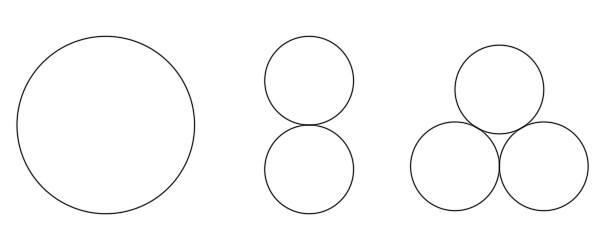
Three wires are stable as the interacting forces between the wires will always form a triangle – each wire has two points of contact and the distance between the axis of the wires will always be at a minimum.
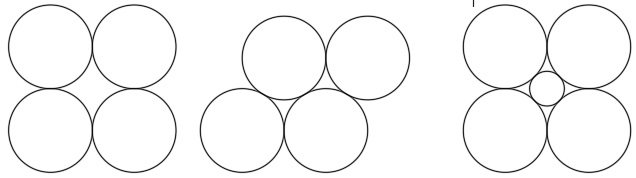
Four wires is unstable. Although each wire has two points of contact the points of contact can move and is shown in the following sketches. For a “four” wire strand to be stable a small fifth wire needs to be added as a core to provide support for the wires and prevent the construction from collapsing. Thus a four wire strand will become a five wire strand. From this point, strand shape is dictated by the geometry of round wires, and as larger more flexible strands are required more wires are added.
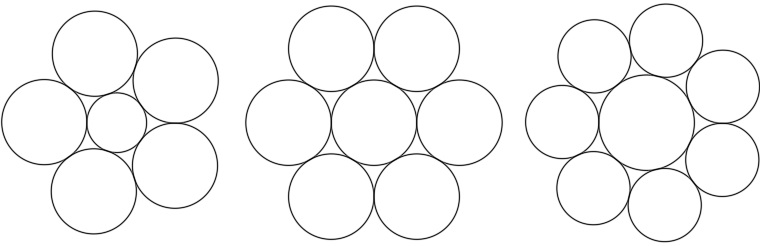
The above discussion of a five wire strand illustrates the need to calculate the relative wire diameters of the wires in a layer and the diameter of the supporting wires. This can be done mathematically with simple geometric calculations: