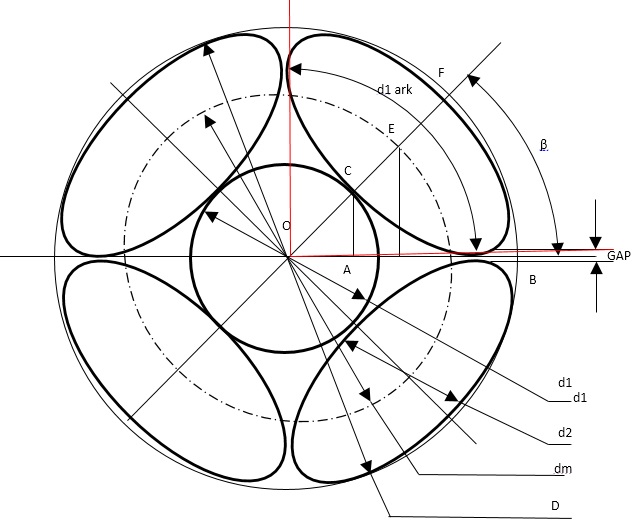
The calculations developed in the “circular theory” are thus not valid to accurately determine the wire diameters used to make a strand. A theory is required to accommodate the lay angle of the wires in the strand.
For small lay angles, long lay lengths, the shape of the wires in cross- section can be approximated with reasonable accuracy by assuming the cross section is an ellipse. Thus the major axis of the wire in cross section can be determined by:
Where β is the lay angle of the wire layer.
The major diameter of the ellipse can be calculated by:
dma = d1 X tan(lay angle)

At this point we introduce the concept of a wire gap. If we were to use the wire diameters calculated in the circulate theory with a lay angle we would have a negative wire gap or interference between the wires. Since in real life a wire cannot be pushed into another wire, we cannot design a strand with negative wire gaps. (Except compact strands which require specialised equipment to manufacture this is covered in the manufacturing section)
The equations developed from this point include a gap calculation routine to ensure that the wires will fit with in the layer. The gap is calculated by determining the mean wire layer diameter and comparing it to the sum of the major axis.
The figure on the right shows the basic concept but there are still errors in the dimensions:
- The wire layer pcd does not pass through the point of contact between the wire edge and the major axis.
- The arc length of the points between the major axis points on the wire edge is longer that the straight line axis.
The wire contact points are not at the major axis points

The sketch on the right emphasizes the differences between the major axis arc length and the position of the PCD when the lay of the wire layer is very short.

If we revisit our previous calculation of a 4/1 strand, we can develop the following equations:
FOUR OVER ONE
The strand diameter D = d1 + 2d2
The number of wires in the layer = N = 4
The centre angle = β = π/N
The Mean diameter Dm = d1 + d2
The major axis = d2 tan θ
The wire arc length is
d1 arc = )
The apparent gap is found by deducting the sum of the arc lengths from the mean wire layer diameter. (Segment length – Large ovality axis)
Gap1 =
The actual gap can be found from:
Gap =
Through a series of iterations of changing the wire diameters and lay angle the ideal wire sizes can be found that meet the required gap specifications